
EvenSkyn MicroInfuser Review: Does It Work
We may earn a commission from some links on this page.
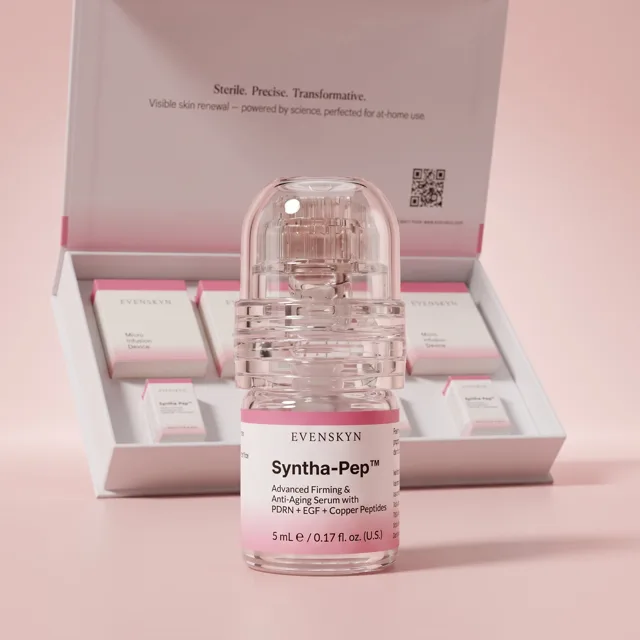
The EvenSkyn MicroInfuser is an at-home micro-infusion system: a sterile microneedle head clicks onto a sealed ampoule of serum, and the serum goes on in the same motion as the stamping. EvenSkyn sells it as a kit of four treatments with its own PDRN serum, Syntha-Pep, and describes the device as a cosmetic tool rather than a medical one. Below is what the maker states about the kit, how a session is meant to run, where the design is careful and where it asks you to trust the brand.
Key Takeaways
- It is a micro-infusion kit rather than a microneedling pen: a single-use needle head and a single-use serum ampoule, used together once.
- EvenSkyn lists a nominal needle length of 0.5 mm, fixed in the head, with gold-plated needles that are gamma-sterilised and used once.
- The serum is sealed in a 5 mL ampoule that connects straight to the head, so there is no refillable chamber and no pouring step.
- The maker puts the PDRN in Syntha-Pep at 2,000 ppm and states it is biosynthetic, not salmon-derived.
- One kit is four treatments, and EvenSkyn recommends one session every two weeks, in the evening.
What the Kit Contains
A kit is built around consumables, not around a reusable device with a bottle you fill. Each session takes one sterile needle head and one sealed 5 mL ampoule of Syntha-Pep, and both are used once and thrown away. EvenSkyn sells the kit as a two-month supply of four treatments, with four ampoules and four heads, and offers four-month and six-month supplies that add more kits at the same four-treatments-per-kit rate.
That structure is the main difference between this and the refillable devices in the same category. There is nothing to clean out between sessions, nothing to decant, and no chamber where serum sits exposed to air. The trade-off is that every session needs a consumable that has to be bought again.
The serum itself is the other half of the kit. EvenSkyn lists biosynthetic PDRN at 2,000 ppm, sh-Oligopeptide-1, Copper Tripeptide-1, a four-form hyaluronic acid system, niacinamide, ergothioneine and Centella Asiatica extract. The maker states the PDRN is made in a lab and is not derived from salmon, and publishes the supplier declaration and batch certificates on its own transparency page.
How a Session Runs
EvenSkyn describes a session as short: about five to ten minutes, once every two weeks, in the evening. The ampoule clicks into the head, the serum is delivered as the head is pressed against the skin, and the head and ampoule are disposed of afterwards. Because the serum path is sealed from ampoule to needle, the make-or-break step is technique rather than mixing or filling.
The maker is unusually direct about one point that brands often blur. Nominal needle length is not the same as delivery depth, and EvenSkyn says so on the product listing: 0.5 mm is how long the needle is, not a measurement of where the serum ends up. Any brand quoting a precise delivery depth in microns is quoting something nobody has measured on their device.
That also sets expectations for what the kit can and cannot do. It is a surface treatment with a short needle, sold as a cosmetic device, so it is not a substitute for an in-clinic procedure and EvenSkyn does not present it as one.
Detailed Features
These are the specifications EvenSkyn publishes for the kit, in the maker's own terms.
| Feature | What EvenSkyn States |
|---|---|
| Nominal needle length | 0.5 mm, fixed in the head |
| Needles | 24 karat gold-plated, single use, individually gamma-sterilised |
| Serum architecture | Sealed ampoule connecting directly to the head, with no pour-and-fill chamber and no transfer step |
| Serum | Syntha-Pep, 5 mL sealed single-use ampoule, one per session |
| Key actives | Biosynthetic PDRN at 2,000 ppm, sh-Oligopeptide-1, Copper Tripeptide-1, four-form hyaluronic acid, niacinamide, ergothioneine, Centella Asiatica extract |
| Session length | About 5 to 10 minutes |
| Recommended cadence | Once every two weeks, in the evening |
| Consumables per session | One needle head and one serum ampoule |
| Manufacturing | Cleanroom serum fill under Good Manufacturing Practice, ISO-certified facility |
| Regulatory status | Cosmetic device; not a medical device and not FDA-cleared |
The two lines worth reading twice are the regulatory status and the guarantee. EvenSkyn is explicit that the kit is a cosmetic device, and its 60-day money-back guarantee covers unused treatments for buyers in the United States and Canada. There is no separate warranty.
Advantages and Disadvantages Overview
The design has real strengths. The sealed ampoule removes the messiest and most contamination-prone part of home micro-infusion, since nothing is decanted or stored between sessions. Single-use heads mean no sharpening and no cleaning routine. The maker also publishes figures the category usually leaves out, including the PDRN concentration and the batch certificates, and the product listing carries 16 customer reviews averaging 4.9 out of 5.
The disadvantages are mostly about commitment and proof. Every session needs a consumable, so the running cost never stops, and the kit only makes sense if you keep up a fortnightly routine. The evidence behind the serum is formulation data, not published trial results; EvenSkyn says it ran an internal study but does not quote results from it, which is honest but leaves you trusting the ingredient list. And with a 0.5 mm nominal needle, this is a light treatment, so anyone expecting clinic-level resurfacing will be disappointed.
Other Tools That Do a Similar Job
Not everyone wants a consumable kit. If the goal is smoother texture rather than serum delivery, a device that exfoliates with a spinning disc is the other common route at home, and the PMD Personal Microderm Pro is a common alternative to micro-infusion kits; it offers several speeds and disc strengths so you can step up from a gentle pass. It works on the surface and does not infuse anything, so it is a different treatment rather than a cheaper version of the same one.
If the appeal is simply a short needle and a serum, the simplest way in is a hand-held roller. The Cosmedica Microneedling Derma Roller has 540 fine needles and is made to be rolled over the skin before a serum or cream, and it costs a fraction of a kit. What it does not give you is the sealed ampoule, the single-use head or the fixed depth, so it asks more care of the person using it.
Frequently Asked Questions
How Often Should the MicroInfuser Be Used?
EvenSkyn recommends one session every two weeks, in the evening. That spacing is part of the design: each session uses one head and one ampoule, so the fortnightly rhythm and the four treatments in a kit line up with a two-month supply.
How Long Does a Kit Last?
One kit is four treatments, which the maker calls a two-month supply at the recommended cadence. Larger options bundle two or three kits for four or six months, and the ampoules and heads are counted out to match: eight treatments in the four-month option and twelve in the six-month one.
Can It Be Used With Other Skincare Products?
The kit is built to deliver its own serum, so there is no mixing step and no need to add anything to the ampoule. EvenSkyn sells a PDRN serum separately for the days between sessions, and its own guidance treats micro-infusion and radiofrequency as two different treatments that should not be run on the same day, with a spacing rule between them.
What About the Needle Heads?
Heads are single use and individually gamma-sterilised, and each one is used once with its own ampoule and then discarded. There is nothing to clean, sharpen or store, but it also means a head is part of every session's cost.
Is It a Medical Device?
No. EvenSkyn describes the MicroInfuser as a cosmetic device, states that it is not a medical device and that it is not FDA-cleared, and sells it with a 60-day money-back guarantee on unused treatments for buyers in the United States and Canada.